Agentic AI Product End-to-End Lifecycle Management
A practical 10-stage framework for moving from Agentic AI opportunity to governed enterprise operations
Building an AI agent is becoming easier. Running one safely and economically inside a real enterprise is not.
I use the following 10-stage lifecycle to structure that journey—from deciding where Agentic AI belongs, through authority and architecture design, to production operations, measurable value and continuous learning.
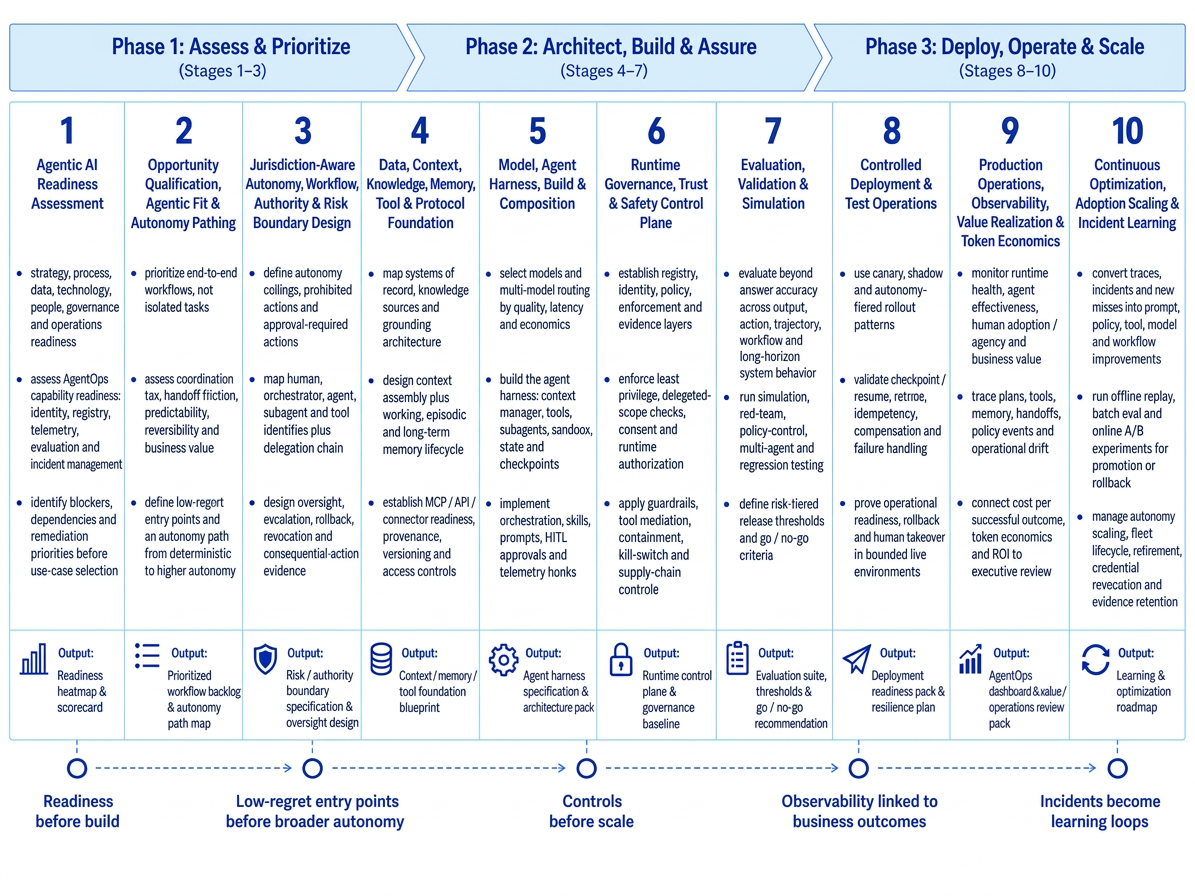
Three Phases. Ten Management Stages.
Phase 1 — Assess and Prioritize
1. Agentic AI Readiness Assessment
2. Opportunity Qualification, Agentic Fit & Autonomy Pathing
3. Jurisdiction-Aware Autonomy, Workflow, Authority & Risk Boundary Design
Phase 2 — Architect, Build and Assure
4. Data, Context, Knowledge, Memory, Tool & Protocol Foundation
5. Model, Agent Harness, Build & Composition
6. Runtime Governance, Trust & Safety Control Plane
7. Evaluation, Validation & Simulation
Phase 3 — Deploy, Operate and Scale
8. Controlled Deployment & Test Operations
9. Production Operations, Observability, Value Realization & Token Economics
10. Continuous Optimization, Adoption Scaling & Incident Learning
The lifecycle is not a strict waterfall. Some work runs in parallel, and production evidence should continuously feed back into earlier decisions.
One principle runs through all ten stages:
Greater autonomy should be earned through evidence, not assumed at design time.
Phase 1 — Assess and Prioritize
1. Agentic AI Readiness Assessment
Purpose
Do not begin with a model or agent framework.
Begin by asking whether the enterprise can absorb, control and operate Agentic AI beyond a prototype.
A team may be capable of building a strong demo while still lacking the process discipline, identity architecture, integration foundation, evaluation capability or operational ownership required for production.
This stage identifies those gaps early.
What to assess
Readiness should cover seven areas.
Strategy
Is Agentic AI connected to a meaningful business, customer or workforce outcome?
Process
Is the target work understood well enough to redesign, measure and improve?
Data & Knowledge
Are authoritative sources available, current and accessible?
Technology
Are APIs, systems of record, event architecture and integration patterns ready for agent access?
People & Organization
Can roles, responsibilities and Human–AI ways of working change?
Governance
Are accountability, security, ownership and control structures sufficiently clear?
Operations
Can the enterprise monitor, evaluate, investigate, recover and improve an agent after it goes live?
That final point matters.
An organization can be experiment-ready without being production-ready.
Add an AgentOps capability lens
Generic AI maturity assessments are not enough.
For Agentic AI, I also look for operating capabilities such as:
- agent and workload identity;
- agent, model and tool registries;
- runtime telemetry;
- evaluation infrastructure;
- credential management;
- incident management;
- configuration and version management;
- controlled production rollout;
- clear operational ownership.
A more useful maturity progression is:
Experiment-ready → Pilot-ready → Production-ready → Scale-ready
Typical outputs
- Readiness Heatmap
- Readiness Scorecard
- Agentic Operating Readiness Profile
- Gap Register
- Remediation Priority List
- Executive Readiness Briefing
- Go / Pilot Only / Remediate First Recommendation
Key decision
Are we ready to select and build an Agentic AI use case—or would we simply be putting technical debt around a good demo?
2. Opportunity Qualification, Agentic Fit and Autonomy Pathing
Purpose
The next question is not “Where can we deploy an agent?”
It is:
Where does agency create enough additional value to justify the additional complexity and risk?
The unit of analysis should usually be an end-to-end workflow, not an isolated task.
Decompose the work
A useful starting point is:
Input → Judgment → Action → Exception → Handoff
Look for:
- repetitive processing;
- repeated decisions;
- information gathering;
- waiting;
- verification;
- reconciliation;
- routing;
- approvals;
- exception handling;
- repeated transfer of context between people and systems.
Look for the coordination tax
Some of the largest opportunities are not inside a task but between tasks.
Time is often lost in:
- checking status;
- reconciling information;
- obtaining approval;
- moving work between teams;
- re-entering information;
- verifying another party’s work;
- waiting for the next actor.
Agentic AI can create value by removing or redesigning that coordination layer, not simply automating individual activities.
Distinguish automation from agency
I separate three broad patterns.
Deterministic automation
Rules and sequences are known.
AI-assisted work
AI generates or interprets information, but humans retain execution.
Agentic work
The system must interpret context, choose among actions, use tools, adapt a plan or handle exceptions.
If conventional workflow automation solves the problem well, adding an agent may only add latency, cost and risk.
Qualification variables
Useful criteria include:
- business impact;
- execution feasibility;
- agentic differentiation;
- output predictability;
- verifiability;
- reversibility;
- action criticality;
- exception density;
- human-verification burden;
- coordination friction;
- regulatory sensitivity;
- current fully loaded cost.
Define an autonomy path
Autonomy should be treated as a progression rather than a binary choice.
For example:
Deterministic execution → AI assistance → Recommendation → Human delegation → Approval-gated action → Bounded autonomous execution
The initial level should reflect current evidence, not long-term ambition.
Typical outputs
- Prioritized Workflow / Use-Case Backlog
- Coordination & Handoff Friction Map
- Agentic Fit Assessment
- Autonomy Path Map
- Excluded / Deferred Use-Case List
- Initial Business-Case Hypothesis
- Initial KPI Hypothesis
- Quick-Win / Advanced-Agent Backlog
Key decision
Does this work genuinely need agency, and what is the lowest-regret autonomy level from which to begin?
3. Jurisdiction-Aware Autonomy, Workflow, Authority and Risk Boundary Design
Purpose
This is where Agentic AI becomes an authority and operating-model problem, not only an engineering problem.
The central question is:
Who can act on whose behalf, within what limits, with what oversight—and who remains accountable?
Technical capability does not equal authority.
An agent may be capable of performing an action without being permitted to perform it.
Define the agency envelope
Material actions should be divided into clear zones:
Prohibited
Allowed
Approval-required
The envelope should also define:
- data access;
- tool access;
- system access;
- financial or transaction limits;
- customer-impact limits;
- time limits;
- mandatory review;
- escalation;
- rollback;
- authority suspension and revocation.
Design identity and delegation
Agentic workflows can involve chains such as:
Human → Enterprise Application → Orchestrator → Agent → Subagent → Tool
Identity and authority context need to survive that chain.
A delegated task should not silently acquire more authority simply because it moves to another agent or tool.
This makes principal identity, delegated scope and authorization context first-class design elements.
Define approval and consent
Some authority can be pre-delegated.
Some actions require approval at execution time.
Some actions should remain permanently human-controlled.
Those distinctions should be explicit.
Translate regulation into controls
At Stage 2, regulation helps screen unsuitable opportunities.
At Stage 3, relevant requirements become actual operating design:
- autonomy ceilings;
- mandatory human review;
- evidence requirements;
- escalation thresholds;
- reportable-event criteria;
- prohibited actions;
- accountable ownership.
Human oversight is not one control
Different patterns may coexist.
Human-in-the-loop
The action waits for approval.
Human-on-the-loop
The agent acts inside a defined envelope while humans supervise.
Exception-based oversight
Humans become involved only when specific thresholds are breached.
The appropriate model depends on materiality, uncertainty, reversibility and accountability.
Typical outputs
- Risk & Authority Boundary Specification
- Agent Identity / Principal / Delegation Map
- Agency / Autonomy Envelope
- Human Oversight Matrix
- Consent / Approval / Authorization Matrix
- Allowed Tool / Data / System Map
- End-to-End Workflow Blueprint
- Process / Decision / Control Map
- Escalation & Human-Takeover Thresholds
- Exception / Rollback / Authority-Revocation Design
- Consequential-Action Evidence Requirements
Key decision
How much agency should the system actually be allowed to exercise?
Recommended Resources — Curated by InJun Kim
- NIST — Software and AI Agent Identity & Authorization · Public concept paper
A useful foundation for agent identification, authentication, authorization, auditing and non-repudiation. NIST has since received more than 600 stakeholder responses and is moving toward implementation use cases. NIST Computer Security Resource Center
Open the NIST Agent Identity & Authorization work - Authorization Architectures for Tool-Using AI Agents · Research — September 2026
Particularly relevant for principal hierarchy, delegation across multi-hop agent chains, runtime policy-enforcement points, provenance and non-repudiation. arXiv
Read the paper - NIST IR 8587 — Protecting Tokens and Assertions from Forgery, Theft, and Misuse · Final guidance — September 2026
Useful for the token, assertion, key-management and lifecycle controls that sit underneath delegated agent authority. NIST Computer Security Resource Center
Read NIST IR 8587 - IMDA — Model AI Governance Framework for Agentic AI · Public governance framework
A practical complement for autonomy, human accountability, third-party agents and multi-agent governance. The May update added implementation examples and case studies. IMDA
Explore the IMDA framework
Phase 2 — Architect, Build and Assure
4. Data, Context, Knowledge, Memory, Tool and Protocol Foundation
Purpose
Traditional AI architecture focused heavily on data.
Agents need a broader foundation: a context supply chain.
The system must assemble the right combination of:
- instructions;
- current task state;
- enterprise knowledge;
- historical context;
- memory;
- tool schemas;
- system state;
- permissions.
Establish sources of truth
For important enterprise facts, the agent should be able to distinguish:
system-of-record state
from
retrieved knowledge
from
memory
from
inference
from
user-provided information.
That distinction becomes much more important when the system can act on what it believes.
Engineer context
The goal is not simply to maximize context-window size.
It is to determine:
- what is needed now;
- what should be retrieved;
- what belongs in working context;
- what can be summarized;
- what should be compressed;
- what should be excluded.
Treat memory as a lifecycle
Useful memory design goes beyond conversation history.
A practical lifecycle is:
Create → Retrieve → Update → Consolidate → Compress → Forget → Delete
Different forms of memory may serve different purposes:
- working memory;
- episodic memory;
- long-term semantic memory;
- customer context;
- workflow state;
- auditable history.
Treat tools and protocols as dependencies
Agents increasingly access enterprise capabilities through:
- APIs;
- MCP servers;
- connectors;
- agent-to-agent protocols.
For every integration, know:
- who owns it;
- which version is active;
- what data it receives;
- what it can change;
- what permissions it requires;
- how it is authenticated;
- whether a third party can change its behavior.
MCP and A2A solve different problems
MCP increasingly serves the agent-to-tool / context interface.
A2A addresses agent-to-agent interoperability across independently built systems.
A2A v1.0 is now a stable, production-ready open protocol, while its September roadmap is already working toward richer streaming, multi-turn workflows, HITL interaction and validation tooling. A2A Protocol
Typical outputs
- Data & Knowledge Inventory
- Source-of-Truth Map
- Context / Grounding Architecture
- Memory Lifecycle Architecture & Policy
- Context Compression Strategy
- Tool & Protocol Registry
- MCP / API / Connector Readiness Checklist
- Tool Provenance / Ownership / Version Map
- System Integration Design
- Data / Tool Access Matrix
Key decision
Can the agent consistently obtain the right context and use the right capabilities without exceeding its authority?
Recommended Resources — Curated by InJun Kim
- Model Context Protocol — 2026-07-28 Specification · Open protocol
The current major MCP specification introduced a stateless core, authorization hardening, extensions and updated SDK support. Model Context Protocol Blog
Read the MCP 2026-07-28 release - MCP — Current Roadmap · Open roadmap — August 2026
Worth following for enterprise readiness, governance maturation and the next protocol priorities. Model Context Protocol Blog
Read the MCP roadmap - Agent2Agent Protocol v1.0 + Roadmap · Open standard
A strong companion to MCP for interoperable multi-agent systems. The current roadmap includes bidirectional streaming, HITL/multi-turn workflows, CLI/harness integration and conformance tooling. A2A Protocol
Explore A2A - ACON — Optimizing Context Compression for Long-Horizon LLM Agents · ICML 2026 research
Useful for understanding context quality and compression as long-horizon agents accumulate state. - Memora — A Harmonic Memory Representation · ICML 2026 research
A useful reference for thinking about scalable memory beyond chat history or straightforward vector retrieval.
5. Model, Agent Harness, Build and Composition
Purpose
The model is only one part of a production agent.
What increasingly matters is the Agent Harness around it: the layer that manages context, tools, subagents, state, execution environments, approvals and telemetry.
Select models by task and value
Model strategy should consider:
- quality;
- reasoning capability;
- latency;
- multilingual performance;
- tool reliability;
- context capacity;
- safety requirements;
- economics.
Many production systems will use model routing rather than a single model everywhere.
Use the expensive or highly capable model where the task warrants it.
Do not pay for capability the workflow does not need.
Build the harness
A production harness may include:
- context manager;
- model router;
- retrieval;
- memory;
- tool loader;
- skills and instructions;
- subagent manager;
- sandbox;
- file workspace;
- workflow state;
- checkpoints;
- approval gates;
- logging;
- evaluation hooks;
- policy integration.
Choose orchestration deliberately
Common patterns include:
- single agent;
- agent with tools;
- supervisor;
- agents-as-tools;
- handoff architectures;
- specialist subagents;
- graph workflows;
- broader multi-agent systems.
More agents do not automatically mean a better architecture.
More coordination can also mean:
- more latency;
- more tokens;
- more failure paths;
- more context loss;
- harder attribution.
Keep deterministic structure where useful
Some parts of a workflow benefit from agent reasoning.
Others are better expressed as deterministic graph logic.
A good production system can combine both.
Version behavior
Track more than source code.
Important behavioral configuration includes:
- model ID;
- system instructions;
- prompt and skill versions;
- tool descriptions;
- policies;
- routing rules;
- harness configuration;
- agent configuration.
If behavior changes, you should know what changed.
Typical outputs
- Model Decision & Routing Record
- Agent Harness Specification
- Agent / System Architecture
- Agent Artifact & Version Manifest
- Prompt / Skill / Policy Package
- Tool Interface & Contract Definitions
- Memory / State Logic
- Orchestration / Subagent Flow
- Sandbox / Working-Environment Specification
- HITL / HOTL Design
- Instrumentation / Evaluation Hooks
Key decision
Have we built an operable agent system—or only a compelling demo?
Recommended Resources — Curated by InJun Kim
- OpenAI Agents API · Public Beta — updated 29 September 2026
The managed harness now spans persistent execution, tools and agent environments; the latest update adds hosted computer use, while GPT-6.1 Sol supports multi-agent delegation in beta. OpenAI Developers
Explore the OpenAI Agents API and current changelog - Google ADK — Graph Workflows · Open framework — September 2026
A useful implementation reference for deterministic graph structure, agent routing, fan-out/fan-in, parallel workers and human-review pauses. Google Cloud
Read the ADK Graph Workflows guide - Microsoft Agent Framework · Open framework
Useful for combining agents, workflows, state, tools, HITL and durable execution patterns. - Pydantic AI Harness · Open framework
Particularly useful for looking at harness capabilities such as workspace, persistence, context management and durable execution.
6. Runtime Governance, Trust and Safety Control Plane
Purpose
The authority boundaries from Stage 3 now need to become runtime controls.
Policy documents are not enough.
The runtime has to determine, on every relevant action:
- who is acting;
- what authority they have;
- what policy applies;
- whether the action is allowed;
- whether approval is required;
- what evidence needs to be recorded.
Five control layers
I use five connected layers.
Registry
What agents, models, tools and policies exist?
Identity
Which principal, service or agent is acting?
Policy
Which rules apply?
Enforcement
Where is that policy technically enforced?
Evidence
Can the enterprise reconstruct what happened and why?
Default deny and least privilege
Agents can combine multiple tools and permissions dynamically.
That makes familiar security principles even more important:
- least privilege;
- default deny;
- short-lived credentials;
- delegated scope;
- just-in-time authorization;
- action-specific approvals.
Security outside the agent
One important recent direction is to move enforcement outside the agent process itself.
The agent should not be able to reason its way around the control.
NVIDIA OpenShell, released in late September, follows this pattern: agents run in isolated sandboxes, permissions are policy-controlled, and enforcement occurs outside the agent process with auditable allow/deny decisions. NVIDIA Developer
Govern actions, not just generated content
Important failures may come from:
- wrong tool;
- wrong parameters;
- unintended external side effect;
- excessive permissions;
- prompt injection;
- poisoned memory;
- malicious connector;
- unsafe tool chaining.
The control plane needs to govern action paths.
Close the gap between evaluation and governance
A useful governance loop is:
Find the failure → Measure it → Generate or refine a control → Enforce it → Rerun the same evaluation
That turns governance from policy review into evidence-backed engineering.
Containment
Production agents need mechanisms to reduce or remove agency quickly:
- rate limits;
- spend limits;
- circuit breakers;
- network restrictions;
- tool blocking;
- session termination;
- manual mode;
- credential revocation;
- authority revocation;
- kill switches.
Typical outputs
- Runtime Control Plane Architecture
- Enterprise Agent / Tool / Model / Policy Registry
- Governance Control Library
- Runtime Policy / Guardrail Set
- Identity / Permission / Delegated-Authority Model
- Credential / Token Lifecycle Specification
- Tool / MCP Gateway Controls
- Policy-Decision / Audit-Evidence Schema
- Fallback / Containment / Kill-Switch Plan
- Compliance Evidence Pack
Key decision
Can the enterprise technically enforce the boundaries it says it has?
Recommended Resources — Curated by InJun Kim
- NEW — NVIDIA OpenShell & Open Agent Safety Platform · Open source — September 2026
One of the more interesting recent runtime-control projects: sandboxed agent execution, external policy enforcement, credential protection and auditable allow/deny decisions. NVIDIA Developer
Explore NVIDIA OpenShell - NEW — Microsoft run-assert-eval · Open tooling — September 2026
Links risk discovery, behavioral evaluation and runtime policy into one loop: identify a failure, create an enforceable intervention and rerun the evaluation to see whether the control actually worked. Command Line
Explore run-assert-eval - OWASP — Agent Control Standard · Open standard
Useful for runtime intervention points, inspectability, policy enforcement and control portability. - Microsoft Agent Governance Toolkit · Open source / Public Preview
Provides deterministic policy enforcement, identity, isolation, kill switches and audit tooling. It remains explicitly Public Preview. GitHub
Explore the Agent Governance Toolkit
7. Evaluation, Validation and Simulation
Purpose
A correct final answer does not prove that an agent behaved correctly.
An agent may produce the expected result after:
- calling the wrong system;
- using the wrong parameters;
- taking unnecessary actions;
- breaching policy;
- creating downstream risk.
Evaluation therefore needs to move from answer quality to behavior quality.
Five levels of agent evaluation
Level 1 — Output
Was the result correct, relevant, grounded and safe?
Level 2 — Action / Tool
Did the agent choose the correct tool and use the correct arguments?
Level 3 — Trajectory
Was the sequence of planning and action appropriate, efficient and safe?
Level 4 — Workflow
Did the system complete a realistic business workflow, including exceptions and handoffs?
Level 5 — Long-Horizon / System
Does the agent remain reliable across:
- extended execution;
- changing state;
- multiple tools;
- delayed effects;
- repeated interactions;
- multi-agent coordination?
Build evaluation sets from several sources
Use a mix of:
- golden cases;
- representative production cases;
- historical failures;
- boundary cases;
- adversarial scenarios;
- policy-sensitive cases;
- incident-derived cases.
A single benchmark is not enough.
Evaluate controls
Approval logic, authorization, fallback, escalation, kill switches and spending limits should also be tested.
A control that has never been exercised is not yet a proven control.
Use risk-tiered release criteria
A research agent and an agent that changes a customer’s financial position should not share the same release threshold.
Acceptance criteria should reflect:
- materiality;
- reversibility;
- customer impact;
- autonomy;
- regulatory exposure;
- consequence severity.
Typical outputs
- Evaluation Report & Scorecard
- Golden / Historical / Adversarial Evaluation Suite
- Risk-Tiered Release Thresholds
- Failure Taxonomy
- Tool / Action Results
- Trajectory Results
- Workflow Validation Results
- Long-Horizon / Multi-Agent Test Results
- Regression Suite
- Red-Team Findings
- Go / Conditional-Go / No-Go Recommendation
Key decision
Do we have enough evidence to justify real-world operation?
Recommended Resources — Curated by InJun Kim
- DeepEval — AI Agent Evaluation Metrics · Open source
Includes trajectory-level Task Completion, Step Efficiency, Plan Quality and Plan Adherence, plus tool and argument correctness. GitHub
Explore DeepEval agent metrics - ATBench — Long-Horizon Agent Safety · Open research benchmark
Evaluates safety failures that emerge over realistic multi-step trajectories rather than isolated responses. arXiv
Read ATBench - Amazon Bedrock AgentCore Evaluations · Production evaluation reference
Supports online scoring of production traces and on-demand regression testing, including task completion and expected tool sequences. Amazon Web Services, Inc.
Explore AgentCore Evaluations - Arize Phoenix · Open source / self-hostable
Useful for traces, versioned datasets, experiments, evaluation and replay in one open environment. GitHub
Explore Phoenix
Phase 3 — Deploy, Operate and Scale
8. Controlled Deployment and Test Operations
Purpose
Passing an evaluation suite does not justify unrestricted production.
The first live environment should be intentionally bounded.
This stage tests operational behavior under real conditions.
Stage autonomy into production
A useful progression is:
Shadow → Read-only → Recommend → Approval-gated action → Bounded autonomous action
Autonomy itself becomes part of deployment strategy.
Design for durable execution
Agents may run for minutes, hours or longer.
They may also fail after already changing external state.
That makes several capabilities important:
- checkpointing;
- pause / resume;
- state restoration;
- retries;
- backoff;
- idempotency;
- duplicate suppression;
- timeouts;
- dead-letter handling;
- compensation.
Manage side effects
Suppose an agent completes three actions out of five and then crashes.
You need to know:
- can the sequence safely retry?
- will a retry duplicate an action?
- can prior actions be reversed?
- is compensation required?
- where should a human take over?
These are normal production questions for autonomous systems.
Test human takeover
A person taking control should know:
- what the agent intended;
- what it already completed;
- what remains pending;
- what state was saved;
- which tools were used;
- what happened immediately before failure.
Human fallback should be rehearsed, not assumed.
Typical outputs
- Version / Release Baseline
- Rollout & Change Log
- State / Checkpoint Strategy
- Runtime Resilience & Recovery Plan
- Side-Effect / Compensation Matrix
- Failure-Handling / Dead-Letter Design
- Operational Runbook
- Rollback / Manual-Fallback Procedure
- Tracing Baseline
- Limited-Production Test Report
- Production-Entry Recommendation
Key decision
Can this agent fail safely in a live environment?
Recommended Resources — Curated by InJun Kim
- Microsoft Agent Framework — Workflow Checkpoints
Covers capturing, restoring and rehydrating workflow state for long-running execution, failure recovery, audit and compliance. Microsoft Learn
Explore Workflow Checkpoints - Pydantic AI — Durable Execution · Open framework
Useful for agents that need to survive process failures, restarts, long waits and HITL interaction. Pydantic
Explore Pydantic AI Durable Execution - Pydantic AI Harness — Step Persistence
A particularly good implementation reference for snapshots, deterministic idempotency keys, tool-effect ledgers, resume and fork semantics. Pydantic
Explore Step Persistence
9. Production Operations, Observability, Value Realization and Token Economics
Purpose
Production AgentOps has to answer more than:
Is the service available?
The more important question is:
Is the Human–AI system producing better outcomes at acceptable cost and risk?
I use four operating layers.
Layer 1 — Runtime Health
Examples:
- availability;
- latency;
- throughput;
- errors;
- retries;
- queue health;
- state failures;
- tool latency.
Layer 2 — Agent Effectiveness
Examples:
- task completion;
- tool success;
- trajectory quality;
- unnecessary actions;
- fallback;
- escalation;
- policy violations.
Layer 3 — Human / Adoption / Agency
Examples:
- usage depth;
- acceptance;
- rejection;
- override;
- verification time;
- escalation;
- handoff quality;
- trust calibration;
- unnecessary human intervention.
A technically healthy agent can still fail here.
Layer 4 — Business Value and Economics
Examples:
- cycle-time reduction;
- cost per outcome;
- quality improvement;
- revenue impact;
- customer outcome;
- employee productivity;
- risk reduction;
- error reduction;
- ROI.
Measure fully loaded economics
Token cost alone does not describe agent economics.
A meaningful comparison is:
Human fully loaded cost per successful outcome
versus
Agentic fully loaded cost per successful outcome
Agentic cost can include:
- model consumption;
- token usage;
- tool calls;
- infrastructure;
- human review;
- exceptions;
- operations;
- failure cost.
The objective is not minimum token consumption.
It is better value per successful outcome.
Make observability agent-aware
Useful traces should distinguish:
- agent invocation;
- workflow invocation;
- planning;
- model calls;
- tool execution;
- retrieval;
- memory;
- handoffs;
- escalation;
- policy decisions.
That makes it possible to see where the agency failed, not simply where an API returned an error.
Connect usage to actual value
Usage and spend are only intermediate signals.
A useful management chain is:
Usage → Task / Workflow → Adoption → Operational Outcome → Financial or Risk Outcome
Recent enterprise analytics work increasingly follows this progression rather than stopping at active users and tokens. OpenAI
Typical outputs
- AgentOps Observability Dashboard
- Four-Layer KPI Scorecard
- Agent Effectiveness / Trajectory Report
- Human–AI Adoption & Agency Report
- Policy / Risk / Escalation Dashboard
- ROI / Cost-per-Outcome Analysis
- Token / Model / Tool Economics Baseline
- Value-per-Token / Model-Mix View
- Human vs Agentic Fully Loaded Cost Comparison
- Business Outcome Tracking Pack
- Executive AgentOps Review Pack
Key decision
Is the system creating measurable enterprise value—not merely AI activity?
Recommended Resources — Curated by InJun Kim
- Google Cloud — KPIs That Actually Matter for Production AI Agents
A useful practical model connecting reliability, workflow adoption and quantified business impact. Google Cloud
Read the production-agent KPI guide - OpenTelemetry — GenAI Agent Semantic Conventions · Development status
Important standards work for agent-aware tracing across agent, workflow, planning and tool operations.
Explore the OpenTelemetry GenAI conventions - OpenAI — How to Connect AI Usage to Business Value · September 2026
A practical reference for moving from adoption and spend toward task-level usage and measurable workflow/business outcomes. OpenAI
Read the value-measurement guide - Arize Phoenix · Open source
Useful for OpenTelemetry-based tracing, evaluation, datasets, experiments and replay. GitHub
Explore Phoenix - FinOps Foundation — AI Model Selection: Value-Driven Consumption Strategy · September 2026
A useful counterweight to the default habit of using the strongest and most expensive model everywhere. FinOps Foundation
Read the AI Model Selection guide - FinOps Foundation — FinOps and Tokenomics
Useful for separating budget accountability from AI-specific technical economics while connecting both back to business outcomes. FinOps Foundation
Read the FinOps and Tokenomics guide
10. Continuous Optimization, Adoption Scaling and Incident Learning
Purpose
Production creates evidence.
Stage 10 turns that evidence into changes to the agent, workflow, controls and operating model.
A practical closed loop is:
Observe → Diagnose → Propose → Offline Validate → Online Experiment → Promote or Roll Back
Optimize the system, not only the prompt
The right corrective action may be:
- change the model;
- change routing;
- improve context;
- change memory behavior;
- add or remove a tool;
- tighten a policy;
- change an approval threshold;
- modify the harness;
- redesign the workflow;
- retrain users;
- reduce autonomy.
Agent optimization is a system problem.
Turn incidents into evaluation assets
Production failures and serious near misses should become:
- new regression tests;
- new adversarial scenarios;
- new policy rules;
- new thresholds;
- new runbook actions.
An incident should make the next version harder to fail in the same way.
Autonomy can go down as well as up
Progressive autonomy does not mean constant expansion.
An agent can be:
Promoted
Held
or
Demoted
based on operational evidence.
Adoption belongs inside AgentOps
Low adoption may indicate:
- weak workflow fit;
- excessive verification;
- poor user experience;
- low trust;
- unclear roles;
- excessive autonomy;
- insufficient autonomy;
- insufficient business value.
Training is only one possible answer.
Manage retirement
A lifecycle should include end of life.
Unused agents should not retain credentials and tool access indefinitely.
Retirement can include:
- credential revocation;
- removal of tool access;
- memory / data disposition;
- evidence retention;
- registry update;
- owner sign-off.
Typical outputs
- Postmortem & Incident-Learning Log
- Optimization Roadmap
- Updated Evaluation Suite
- Versioned Configuration / Agent Artifact Bundle
- Revised Prompt / Skill / Policy / Tool / Model-Routing / Harness Package
- A/B Test Results & Promotion Decision
- Adoption Action Plan
- Autonomy Promotion / Demotion Review
- Next-Domain Expansion Plan
- Agent / Tool Lifecycle Registry Update
- Retirement / Decommissioning Record
- Credential-Revocation & Evidence-Retention Record
Key decision
What should we improve, expand, constrain—or retire based on production evidence?
Recommended Resources — Curated by InJun Kim
- Amazon Bedrock AgentCore — Optimization
One of the clearest current implementations of a trace-driven improvement loop: production traces → recommendations → versioned configuration bundles → evaluation / A/B testing → promotion. AWS Documentation
Explore AgentCore Optimization - Arize Phoenix · Open source
Useful for converting traces into datasets and experiments, replaying changes and comparing variants before rollout. GitHub
Explore Phoenix - Microsoft Agent Governance Toolkit — Reliability & Operations · Public Preview
Useful for operating-control patterns around fleet health, policy enforcement, kill switches and Agent SRE. GitHub
Explore the Agent Governance Toolkit
Four Management Planes Cut Across the Lifecycle
The ten stages are easier to operate when four concerns are treated as persistent management planes.
| Management Plane | Core Question |
|---|---|
| Identity, Delegation & Authority | Who is acting for whom, and how far can that authority travel? |
| Policy, Safety & Runtime Governance | What should be allowed, blocked, approved, escalated or contained? |
| Telemetry, Evidence & Evaluation | What happened, why did it happen, and can we demonstrate that the system remained within expectations? |
| Economics, Value & Adoption | Does the system create enough measurable value to justify its cost, risk and complexity? |
These concerns do not belong to one stage.
They need to persist as the agent moves from architecture to production and scale.
What Changes from a Conventional AI / ML Lifecycle
Traditional AI/ML lifecycle disciplines still matter. Data quality, model selection, evaluation, deployment and monitoring do not disappear.
What changes is the object being managed.
With Agentic AI, the enterprise is no longer managing only a model that produces an output. It is managing a system that can maintain context, use tools, delegate work, change external state and exercise bounded authority.
| Conventional AI / ML | Agentic AI |
|---|---|
| Prediction or generated output | Reasoning, planning and action |
| Data and model as primary dependencies | Context, memory, tools, protocols and identity |
| Model/output governance | Authority, delegation, runtime policy and action governance |
| Output-level evaluation | Action, trajectory, workflow and long-horizon evaluation |
| Model/application deployment | Stateful, durable and side-effecting execution |
| Infrastructure/model monitoring | Agent, tool, memory, handoff and policy observability |
| Compute or inference economics | Cost per successful outcome and value realization |
| Model/prompt iteration | Continuous optimization of model, tools, policy, workflow and autonomy |
In practice, the lifecycle moves from:
Build → Validate → Deploy → Monitor
to:
Qualify → Bound Agency → Engineer → Govern → Validate → Deploy Carefully → Operate → Learn
Business Design and AgentOps Need to Stay Connected
Agent engineering should not begin in isolation.
The business first needs to decide:
- what work should change;
- what should remain human-owned;
- what can be delegated;
- where authority should transfer;
- who remains accountable.
Those choices shape Agentic Fit, autonomy boundaries and architecture.
Production evidence then flows back in the opposite direction:
Work Reinvention → Agency Design → Agent Engineering → Agent Operations → Production Evidence → Work Reinvention
Performance, escalations, overrides, incidents, adoption and economics should all be able to change the original workflow and autonomy design.
That feedback loop is what turns Agentic AI from a technology deployment into an operating model.
The Core Principle
The objective is not to deploy as many agents as possible.
It is to manage:
where agency creates value,
how much authority should be delegated,
how that authority is technically controlled,
and
what evidence is required before autonomy expands.
A production Agentic AI system therefore needs to be:
valuable enough to justify itself · bounded enough to trust · observable enough to understand · resilient enough to operate · governable enough to scale
That is the role of the 10-Stage Agentic AI Product End-to-End Lifecycle.
Resource Curation
Resources under Stages 3–10 are selected for practical relevance, technical depth and recency, with emphasis on:
open-source tools · open standards and protocols · implementation guidance · current research and benchmarks · authoritative public frameworks
Preview, Beta, Draft and Development-stage resources are labelled accordingly.
No sponsorship or commercial affiliation is implied.
Last reviewed: 4 October 2026.
Continue the Conversation
I am continuing to develop and apply this framework through executive education, advisory work and direct engagement with organisations moving from Agentic AI experimentation toward governed, scalable enterprise adoption.
If you are exploring how to identify the right Agentic AI opportunities, design appropriate autonomy and control boundaries, build production-ready agent foundations, or connect AgentOps and token economics to measurable business value, I am open to a deeper discussion.
InJun Kim
injun@injunkim.com


