Human–AI Agent Collaboration for Enterprise Value
From Workforce Desire and Agent Capability to Economics, Adaptive Operating Models and Role-Based Fluency
AI Agents are beginning to move from answering questions to participating in real work.
That changes the transformation agenda. The next phase of enterprise AI is not simply about giving more people access to AI tools. It is about deciding what work should move to AI Agents, what should remain Human-owned, what level of authority should move with that work, and how the enterprise itself must change to turn collaboration into measurable value.
This page shares the core framework I use to think about Human–AI Agent Collaboration at the enterprise level. It is designed to be practical enough for leaders, transformation teams and operating executives to use, while also serving as a foundation for deeper executive education, advisory work and leadership dialogue.
Framework Overview
Three Dynamic Decision Lenses + One Adaptive Human–AI Operating Model
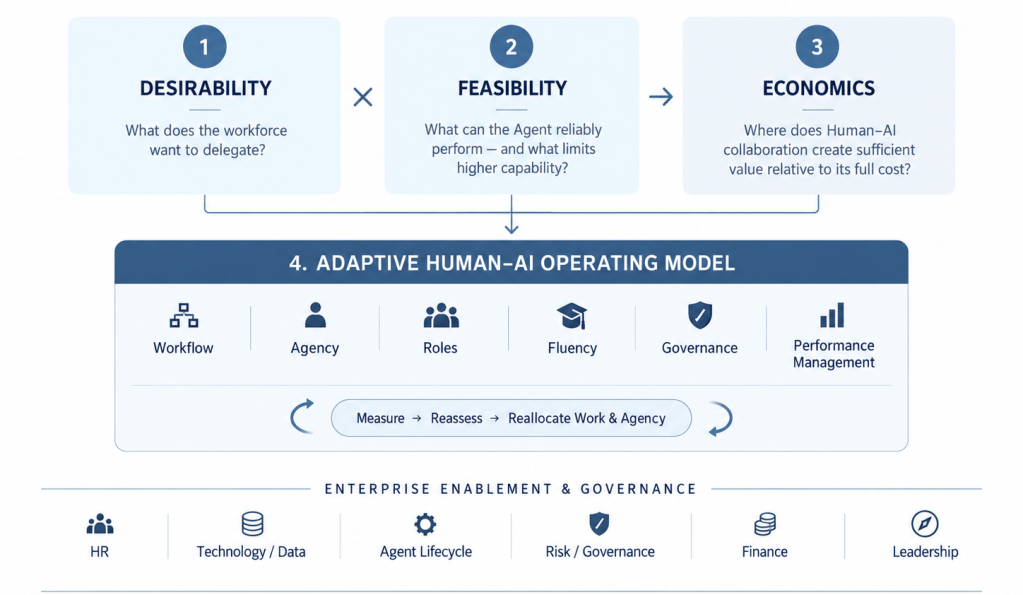
The logic is simple:
1. What does the workforce actually want to delegate to AI?
2. What can the Agent reliably perform — and what prevents higher capability?
3. Does the Human–AI configuration create sufficient value relative to its full cost?
→ 4. How should Work and Agency be designed — and continuously reallocated — between Humans and AI?
How to Use This Page
This page follows the same high-level flow I use in executive education and strategic advisory work:
- Reset the leadership conversation
- Reinvent work before automating it
- Apply the core framework
- Recognise that management itself must change
- Mobilise the surrounding enterprise
- Look ahead
- Start with a practical first 90 days
01 — AI Agents Change Work — Not Just Technology
Much of the early enterprise AI conversation focused on access, adoption, productivity and experimentation.
Those questions still matter. But they are no longer enough.
As AI Agents become more capable of reasoning, using tools, retrieving context and taking actions, leaders need to address a different set of questions:
- What work should AI Agents actually do?
- What work should remain Human-led?
- What level of authority is appropriate?
- How should accountability work when Humans and Agents jointly produce outcomes?
- How should roles, management, governance and economics change as a result?
This is why Human–AI Agent collaboration is not merely a technology question. It is increasingly a work design, operating-model and enterprise value question.
Why collaboration is harder than it first appears
| Human–AI Collaboration Friction | Executive Question |
|---|---|
| Workforce preferences are not reflected in the collaboration model | What does the workforce actually want to delegate? |
| Employees may both overtrust and distrust AI Agents | When should people rely, validate, challenge or override? |
| Role-based AI fluency is missing | Can people perform effectively in the redesigned role? |
| Oversight and exception handling create a new burden | At what point does supervision undermine the value of automation? |
| Ways of working change, but the organisation is not designed to support them | Which workflows, KPIs, incentives and management systems must change? |
| Employees struggle to understand whether Agents are tools or collaborators | What role, authority and accountability should an Agent actually have? |
Emerging Human–Agent collaboration research highlights unresolved challenges around mutual awareness, mixed initiative, failure recovery and shared accountability — reinforcing the point that collaboration itself still requires deliberate design.
02 — Reinvent the Work Before Automating It
Automate the As-Is — or Reinvent the To-Be?
AI Agents do not simply automate the same kind of work that earlier workflow systems or RPA automated.
They create the possibility of reconsidering the work itself.
That creates two different transformation paths.
| Automate the As-Is | Reinvent the To-Be |
|---|---|
| Insert AI into existing steps | Reconsider whether the steps are still necessary |
| Optimise tasks | Redesign workflow |
| Preserve existing handoffs | Remove or restructure handoffs |
| Improve local efficiency | Improve end-to-end business outcomes |
| Keep Human process as the reference model | Make the Human–AI workflow the new reference model |
This distinction matters because some of the biggest opportunities may sit between tasks, not only inside them.
When work moves across teams, systems and approval layers, the organisation often pays a coordination tax. AI Agents may help reduce that tax — but only if leaders are willing to redesign the workflow, not just insert AI into a pre-existing one.
A useful starting question is:
If we were designing this workflow today, with capable AI Agents already available, would we design it the same way?
Only then does it make sense to decide what to delegate.
03 — The Core Framework
Three Dynamic Decision Lenses + One Adaptive Human–AI Operating Model
This is the core of the methodology.
It starts with three dynamic decision lenses:
- Desirability
- Feasibility
- Economics
and then translates them into an:
- Adaptive Human–AI Operating Model
The word dynamic matters.
People change.
Agents improve.
Economics change.
That means the right Human–AI allocation today may not be the right one twelve months from now.
03.1 — DESIRABILITY
What work does the workforce actually want to delegate?
The relevant unit is not “Do employees like AI?”
The relevant unit is the task.
For meaningful work tasks, leaders should ask:
- What would employees willingly delegate?
- Where do they want augmentation rather than automation?
- Where do they believe Human judgment still materially improves the outcome?
- Where is low delegation driven by trust, accountability, incentives or role identity rather than genuine Human advantage?
What low delegation desire may actually mean
| Source of Low Desire | What It May Mean | Typical Response |
|---|---|---|
| Legitimate Human value | Human contribution materially improves the outcome | Preserve Human Agency |
| Trust / performance concern | The Agent is not reliable enough | Improve evidence, escalation and controls |
| Accountability mismatch | Employees remain accountable without visibility or override rights | Redesign authority and workflow |
| Role identity / career concern | Delegation appears to reduce professional value | Redesign role, incentives and progression |
| Poor fluency | Employees do not know how to supervise the Agent | Build role-based fluency |
A mature view of Workforce Desire combines:
- Stated Desire — what employees say they want to delegate
- Observed Delegation Behaviour — what employees actually delegate in real work
This matters because Workforce Desire is not fixed. It may change as trust, fluency, incentives, role definitions and operating experience change.
Desire × Capability: the original diagnostic foundation
| Workforce Desire | Agent Capability | Interpretation |
|---|---|---|
| High | High | Scale Now |
| Low | High | Adoption Resistance |
| High | Low | AI Readiness Gap |
| Low | Low | Lower priority / monitor over time |
03.2 — FEASIBILITY
What can the Agent reliably perform — and what prevents higher capability?
Feasibility should not be treated as a pure model question.
The more useful question is:
How capable is the Agent for this task, inside this enterprise, with this data, these systems and these controls?
A strong foundation model may still produce a weak enterprise Agent if the surrounding environment is immature.
Enterprise capability dimensions
| Capability Dimension | Typical Constraint |
|---|---|
| Data & Knowledge | fragmented, stale or poorly governed information |
| Legacy / API Integration | the Agent cannot access real systems or transactions |
| Tool / Action Pool | the Agent can answer, but cannot perform useful actions |
| Identity & Access | permissions are absent, excessive or poorly governed |
| Context & Grounding | insufficient customer, product, policy or historical context |
| Workflow & Orchestration | weak routing, handoffs or multi-step coordination |
| Evaluation & Reliability | no task-specific reliability testing |
| Observability & Feedback | failures and corrections are not systematically captured |
This leads to a critical management insight:
An AI Readiness Gap may exist not because AI is inherently incapable, but because the enterprise has not yet made the Agent capable.
That means Feasibility should not stop at an As-Is score.
It should also identify:
- Capability blockers
- Target capability
- Uplift actions
For example, an Agent Capability of 2/5 should trigger questions such as:
- Why is it 2?
- What prevents it from becoming 3 or 4?
- Which blockers can the enterprise itself remove?
Applied Financial-Services Benchmark
Workforce Desire × AI Agent Capability Across Five Value Chains
I applied Workforce Desire × AI Agent Capability across five financial-services sectors using task-level worker Automation Desire and expert-rated Automation Capacity from Stanford SALT Lab’s WORKBank/O*NET data.
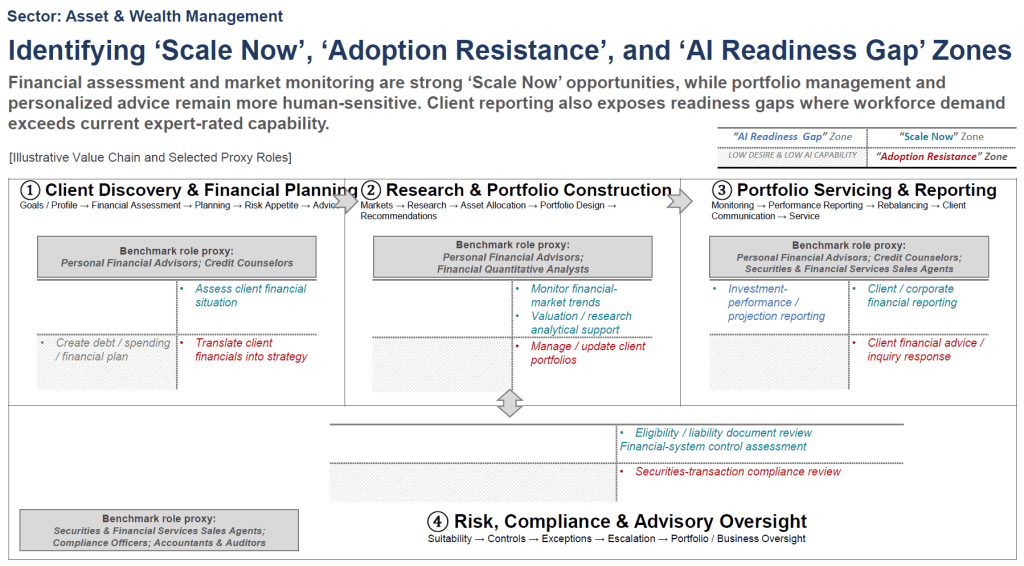
The full paper includes the five sector value-chain benchmarks, organisation-specific diagnostic method, and the worked Trade Credit example covering workflow redesign, role transition and role-based Agentic AI fluency.
The objective was not simply to identify where AI can automate work, but to reveal where workforce willingness and Agent capability align — or diverge — across real value chains, and what those patterns imply for Human–AI work design.
| Sector | Scale Now examples | Adoption Resistance examples | AI Readiness Gap examples |
|---|---|---|---|
| Banking & Lending | Billing/payment setup; bank-transaction reconciliation; applicant financial/credit data; financial-ratio generation | Service/billing complaint resolution; loan approval/escalation; financial-operations improvement | Safety & soundness / compliance reporting |
| Insurance | Policy-data verification; policy/record retrieval; claim-form preparation and completeness | Coverage interpretation; customer/claim communication; claim amount calculation and investigation routing | Cross-functional BI information flow |
| Capital Markets & Investment Banking | Financial/risk reporting; research summaries; valuation support; market/position monitoring | Firm-level financial judgment; order-ticket submission; transaction/regulatory review | Timely cross-functional BI information flow |
| Asset & Wealth Management | Client financial assessment; market monitoring; valuation/research support; client reporting | Translating financials into strategy; portfolio management; personalised financial advice | Investment-performance / projection reporting |
| Payments & Financial Infrastructure | Payment calculation; reconciliation; financial calculations; control-document review | Complaint resolution; discrepancy/control review; oversight of cash/financial-instrument flows | Timely cross-functional BI information flow |
The sector patterns are useful precisely because they are not uniform. Routine preparation, calculation, retrieval and reconciliation tend to show stronger immediate potential, while judgment, approval, customer-sensitive communication and exception-heavy control work more often require deliberate Human Agency and operating-model design. The benchmark also identifies areas where employees may want greater delegation than current AI capability supports — useful signals for the Agent development roadmap.
Replace the Benchmark with Your Own Workforce Evidence
The external benchmark is only a starting point. The same diagnostic can be applied using an organisation’s own workforce and Agent evidence:
Select priority roles/workflows → Define actual tasks → Survey Delegation Desire and why → Assess actual Agent Capability → Replot the findings
For enterprise use, capability should be assessed against your actual Agents, data, systems, tools, controls and workflow context — not only against external model capability.
This converts an external benchmark into a practical enterprise diagnostic for deciding where to scale, where to redesign the Human–AI relationship, and where Agent capability itself must be improved.
From Diagnosis to Work, Role and Fluency Redesign
Trade Credit Insurance Example
The Trade Credit example, in the full paper, shows how the diagnostic can move beyond prioritization into actual operating-model design.
For Credit Analysis & Risk Grading, AI Agents take on more of the preparation layer — financial-data gathering and normalisation, ratio calculation, peer comparison, evidence structuring, risk-brief drafting and monitoring — while Human Agency becomes concentrated on exceptions, context, materiality, final risk interpretation, decision authority and escalation.
That work redesign then changes the roles:
Credit Analyst → Risk Judgment Owner / Exception Analyst
Risk Manager → Human–AI Credit Workflow Coach
Senior Risk SME → Credit Guardrail & Exception Reviewer
Risk Leader → Human–AI Risk Productivity Owner
The resulting fluency programme is therefore role-specific rather than generic AI training. Employees practise realistic Agent scenarios requiring them to:
Delegate · Validate · Challenge · Escalate · Override
with judgment, trust calibration and escalation quality becoming part of proficiency itself.
One-line connection to the expanded framework
This applied two-lens work now forms the Desirability + Feasibility foundation of the expanded framework, which adds Economics before translating the decisions into an Adaptive Human–AI Operating Model.
03.3 — ECONOMICS
Does the Human–AI configuration create enough value relative to its full cost?
This is the major extension beyond the earlier two-lens view.
As Agentic AI matures, the economic question becomes unavoidable.
The right denominator is not just token cost.
The more useful concept is:
Total Cost of Autonomy
| Cost Layer | Examples |
|---|---|
| Reasoning | planning, retries, iterative reasoning |
| Model / Token | input/output, long context, premium models |
| Tools | API calls, SaaS actions, data queries |
| Memory / Context | storage, retrieval, persistent state |
| Orchestration | routers, planners, sub-Agent coordination |
| Monitoring / Evaluation | traces, testing, observability, quality review |
| Governance / Assurance | controls, audit, access review, evidence |
| Human Oversight | review, approval, escalation, override |
| Failure | rework, rollback, customer impact, operational risk |
The value side should also be broader than “hours saved”.
Value categories
| Value Category | Typical Measures |
|---|---|
| Cycle-Time Reduction | turnaround time, response time, handling time |
| Throughput Increase | cases processed, volume per FTE |
| Quality Improvement | error rate, rework, first-time-right |
| Customer Experience | response speed, satisfaction, complaint reduction |
| Risk Reduction | loss avoided, control failures reduced, fraud detected |
| Human Productivity | time released, quality of Human intervention |
| Strategic Speed | decision speed, time-to-value, launch speed |
The practical unit becomes:
Cost per Business Outcome
Examples include:
- Cost per claim resolved
- Cost per credit decision completed
- Cost per customer issue resolved
- Cost per reconciled transaction
The key question is not:
“Is AI cheaper than Human labour?”
It is:
Which Human–AI configuration creates the strongest business outcome relative to its total cost and risk?
That question may lead to surprising answers.
A more capable and more expensive Agent may be economically superior if it sharply reduces Human review or avoids costly downstream errors.
Likewise, an apparently “autonomous” setup may be economically weak once retries, oversight, exception handling and failure exposure are included.
03.4 — ADAPTIVE HUMAN–AI OPERATING MODEL
How should Work and Agency be continuously allocated between Humans and AI?
Once Desirability, Feasibility and Economics have been assessed, they must be translated into a real operating model.
Six design dimensions
| Dimension | Executive Design Question |
|---|---|
| Workflow | What does the Agent do, what does the Human do, and where are the handoffs? |
| Agency | Does the Agent assist, recommend, execute with approval, execute by exception, or act autonomously? |
| Roles | Which Human responsibilities shift toward judgment, exception handling and oversight? |
| Fluency | Can people delegate, validate, challenge, escalate and override effectively? |
| Governance | Who owns the outcome, the authority boundary and the escalation decision? |
| Performance Management | What evidence tells us the allocation should change? |
A practical Agency spectrum
| Agency Level | Agent Role | Human Role |
|---|---|---|
| Assist | retrieve, summarise, draft | performs and decides |
| Recommend | analyse and recommend | evaluates and decides |
| Execute with Approval | prepares action | approves before execution |
| Execute by Exception | acts within defined boundaries | handles exceptions / overrides |
| Autonomous Execute | decides and acts within delegated authority | portfolio oversight / intervention |
The central principle is:
Technical capability does not automatically confer decision authority.
And the operating model should not be static.
Continuous adaptation loop
Measure → Reassess Desirability / Feasibility / Economics → Reallocate Work & Agency
The Human–AI Operating Model must adapt because:
- employees become more or less willing to delegate,
- Agent capability improves or degrades,
- costs change,
- review burdens change,
- business outcomes improve or weaken,
- and governance requirements evolve.
04 — Management Itself Changes
What does a manager manage when part of the workforce is agentic?
This is one of the most underestimated consequences of Agentic AI.
The transformation does not only change frontline work.
It changes management.
As Agents perform more execution, managers may need to manage:
- Human–Agent work allocation
- Agent performance and exceptions
- delegation and escalation thresholds
- Human override quality
- cost-to-outcome
- Human–Agent team performance
The managerial shift
| Traditional Management Focus | Human–Agent Management Focus |
|---|---|
| Who has capacity? | Which work should go to Humans vs. Agents? |
| Who owns the task? | Where are exceptions accumulating? |
| Are SLAs being met? | Is Agent autonomy too high or too low? |
| Is quality acceptable? | Is Human review economically justified? |
| Is the team productive? | Is the Human–Agent configuration creating enough value? |
In other words, management increasingly becomes a question of orchestrating Human judgment and machine intelligence, not only supervising larger Human teams.
05 — The Enterprise Around the Workflow Must Also Change
Enterprise Enablement and Governance
A well-designed Human–AI workflow can still fail if the surrounding enterprise is not aligned.
For example:
- a workflow asks employees to delegate routine work, but performance assessment still rewards individual task volume;
- the business wants more Agent autonomy, but Technology has not created reusable governed tools or identities;
- the Agent is technically effective, but no Business owner is accountable for value after production;
- the Agent releases Human time, but Finance cannot show where that time creates value.
That is why the broader enterprise matters.
What must evolve around the workflow
| Enterprise Function | What Must Evolve |
|---|---|
| HR | roles, skills, workforce planning, performance, incentives, careers |
| Technology / Data | platform, tools, integration, data readiness, identity, observability |
| Agent Lifecycle | onboard, authorise, monitor, improve, expand, constrain, retire |
| Risk / Governance | authority limits, guardrails, Human intervention, auditability |
| Finance | Total Cost of Autonomy, cost-to-outcome, value attribution |
| Leadership | cross-functional ownership, change, continuous adaptation |
A practical ownership principle
Business owns the outcome.
Technology enables Agent capability.
HR redesigns the workforce.
Risk governs authority.
Finance validates the economics.
Leadership drives the change.
06 — What Comes Next
Where Human–AI Agent Collaboration is heading
Several developments are likely to make these issues even more important.
Likely next steps
| Development | Why It Matters |
|---|---|
| Multi-Agent orchestration | the challenge moves from one Human–Agent pair to networks of coordinated Agents |
| Agent identity and authorization | critical as Agents gain access to systems, credentials and actions |
| Agent lifecycle management | leaders must decide which Agents to improve, expand, constrain or retire |
| Economics of autonomous work | portfolio-level value management becomes more important |
| Physical AI | similar questions extend from digital workflows into factories, logistics, healthcare and beyond |
The future is not only more Agents.
It is more complex Human–AI work design, more explicit governance, and a greater need for leaders who understand how to redesign Work, Agency, Management and Value together.
07 — Where to Start
A practical first 90 days
A useful first step is not to launch enterprise-wide transformation.
It is to work on one meaningful workflow.
Days 1–30 — Diagnose
Choose one material workflow. Map tasks, Workforce Desire, Agent Capability and baseline business outcomes.
Days 31–60 — Design
Remove priority capability blockers. Design Human–AI work allocation, authority, role changes, controls and the economic hypothesis.
Days 61–90 — Operate and Learn
Pilot the redesigned workflow. Measure adoption, performance and economics. Decide what to:
Scale · Redesign · Constrain · Stop
The goal is not to find a perfect target state.
It is to build an organisational capability to continuously improve how Work and Agency are allocated between Humans and AI.
Continue the Conversation
I am continuing to develop and apply this framework through executive education, advisory work and dialogue with organisations exploring Human–AI Agent transformation.
If you are considering how to redesign work, management and operating models around AI Agents — whether through an executive programme, leadership workshop, conference session or organisation-specific advisory engagement — I am open to a deeper discussion.
InJun Kim
injun@injunkim.com
Recommended References
Below are several resources I recommend for leaders who want to explore the topic further.
- Future of Work with AI Agents — Stanford SALT Lab / Digital Economy Lab
https://futureofwork.saltlab.stanford.edu/ - Intelligent AI Delegation — Nenad Tomašev, Matija Franklin & Simon Osindero
https://arxiv.org/abs/2602.11865 - Human-Agent Collaboration Workshop — CHI 2026
https://chi26workshop-human-agent-collaboration.hailab.io/ - The CIO’s Guide to AI Tokenomics — Accenture
https://www.accenture.com/en/insights/ai-data/cios-guide-ai-tokenomics - AI Agent Standards Initiative — NIST
https://www.nist.gov/artificial-intelligence/ai-agent-standards-initiative


